Philipp Moll

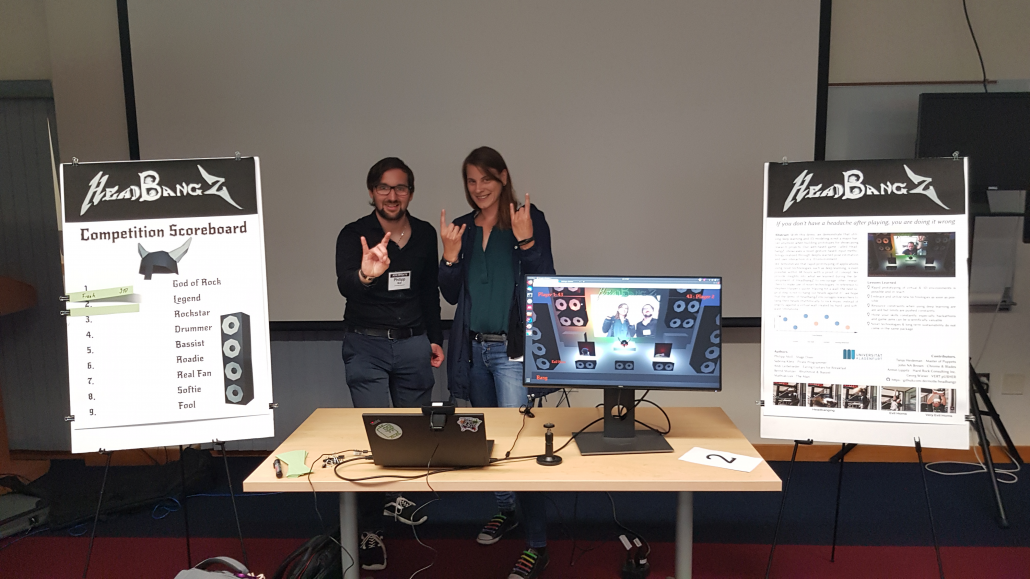
Philipp Moll presented the paper “Distributing the Game State of Online Games: Towards an NDN Version of Minecraft” on the 6th International Workshop on Research Advancements in Future Networking Technologies. The Workshop was held in conjunction with the IEEE International Conference on Communications 2019 in Shanghai.

Authors: Philipp Moll, Sebastian Theuermann, Hermann Hellwagner (Alpen-Adria-Universität Klagenfurt), Jeff Burke (UCLA)

Abstract: Online games nowadays play an undeniably important role in the entertainment industry. The continuously increasing popularity of these services goes hand in hand with increased complexity of technical challenges. The networking part of current games relies on decades-old technologies, which were never intended to be used for today’s large-scale online games. Replacing the currently used connection-oriented networking approach by a content-centric architecture could yield advantages reaching beyond only avoiding inefficiencies found in IP-based online games. We propose a concept for a distributed Minecraft architecture, making use of these advantages by utilizing Named Data Networking (NDN) as the architectural basis. Our design decisions were guided by the insights we gained from examining Minecraft as a representative of current online games.

Mathias Lux, a former student of Peraugymnasium Villach, gave a talk with the topic “Something Something Videogame”.

See more: https://www.peraugymnasium.at/item/714-vortrag-von-di-mathias-lux


This week, we will be playing and discussing all entries from the 6th Klagenfurt Game Jam live on-stream!

Join us on Friday, May 3rd, 11am UTC/1pm CEST at

http://twitch.tv/rarebyte

https://itch.io/jam/6thklujam

Prof. Radu Prodan

Link to the Journal of Grid Computing special issue.

Pictures from the Rigorosum with Prof. Thomas Fahringer and Prof. Justus Piater.

Matthias Janetscheck Defense Pic 1

Christian Timmerer

Authors: Abdelhak Bentaleb, Christian Timmerer, Ali C. Begen, and Roger Zimmermann

Abstract: HTTP adaptive streaming (HAS) with chunked transfer encoding can be used to reduce latency without sacrificing the coding ef- ficiency. While this allows a media segment to be generated and delivered at the same time, it also causes grossly inaccurate bandwidth measurements, leading to incorrect bitrate selections. To overcome this effect, we design a novel Adaptive bitrate scheme for Chunked Transfer Encoding (ACTE) that leverages the unique nature of chunk downloads. It uses a sliding window to accurately measure the available bandwidth and an online linear adaptive filter to predict the available bandwidth into the future. Results show that ACTE achieves 96% measurement accuracy, which translates to a 64% reduction in stalls and a 27% increase in video quality.

Acknowledgment: This research has been supported in part by the Singapore Ministry of Education Academic Research Fund Tier 1 under MOE’s official grant number T1 251RES1820 and the Austrian Research Promotion Agency (FFG) under the Next Generation Video Streaming project “PROMETHEUS”.

Keywords: HAS; ABR; DASH; CMAF; low-latency; HTTP chunked transfer encoding; bandwidth measurement and prediction; RLS.

Link: http://nossdav.org/2019/

Within the scope of the AAU’s young Scientists Mentoring Programme, Andreas Leibetseder is visiting his mentor Oge Marques, Professor at the Department of Computer and Electrical Engineering and Computer Science and Florida Atlantic University (FAU) in Boca Raton, Florida. During his stay over the course of April, he intends to advance in his PhD studies by focusing on the sub-topic of region-based Endometriosis classification in laparoscopic media. He intends to approach this problem by adapting and applying deep learning technologies, profiting from the knowledge and insights of his mentor as well as other students of the local mlab research group (http://mlab.fau.edu/www/). Currently, several work packages have been defined, which include investigating lesion detection approaches on radiological image datasets for application in the endoscopic domain.

The paper “Active Online Learning for Social Media Analysis to Support Crisis Management” was published as an “early access” article in the journal IEEE Transactions on Knowledge and Data Engineering (Q1 in ScimagoJR). The research leading to these results received funding from the EU FP7 Programme under grant agreement no. 261817 and was performed in collaboration with Bournemouth University, UK.

Authors: Daniela Pohl (AAU Klagenfurt, Inst. of Information Technology), Abdelhamid Bouchachia (Bournemouth University, Dept. of Computing, UK), Hermann Hellwagner (AAU Klagenfurt, Inst. of Information Technology)

Abstract: People use social media (SM) to describe and discuss different situations they are involved in, like crises. It is therefore worthwhile to exploit SM contents to support crisis management, in particular by revealing useful and unknown information about the crises in real-time. Read more