
We happily announce, the #Emmy Award Bitmovin (link) for innovation in online TV for @bitmovin arrived at University of Klagenfurt.

Auszeichnungen von ITEC Mitarbeitern
We happily announce, the #Emmy Award Bitmovin (link) for innovation in online TV for @bitmovin arrived at University of Klagenfurt.

The Fast Multi-Resolution and Multi-Rate Encoding for HTTP Adaptive Streaming Using Machine Learning paper from ATHENA lab has won the Best New Streaming Innovation Award in the Streaming Media Readers’ Choice Awards 2021.

The journey that led to the publication of the FaRes-ML paper was quite an insightful one.
It all started with the question, “How to efficiently provide multi-rate representations over a wide range of resolutions for HTTP Adaptive Streaming?“. This led to the first publication, Fast Multi-Rate Encoding for Adaptive HTTP Streaming, in which we proposed a double-bound approach to speed up the multi-rate encoding. After analyzing the results, we saw room for improvement in parallel encoding performance, which led to the second publication Towards Optimal Multirate Encoding for HTTP Adaptive Streaming. The results were promising, but we believed we could improve the encoding performance by utilizing machine learning. That was the primary motivation behind our third paper, FaME-ML: Fast Multirate Encoding for HTTP Adaptive Streaming Using Machine Learning. In FaMe-ML, we have used convolutional neural networks (CNNs) to use the information from the reference representation better to encode other representations, resulting in significant improvement in the multi-rate encoding performance. Finally, we proposed FaRes-ML to extend our FaME-ML approach to include multi-resolution scenarios in Fast Multi-Resolution and Multi-Rate Encoding for HTTP Adaptive Streaming Using Machine Learning paper.
Here is the list of publications that led to FaRes-ML:
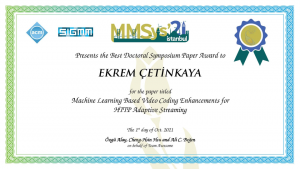
Ekrem Çetinkaya got the Best Doctoral Symposium Paper Award at ACM MMSys 2021 for his paper titled “Machine Learning Based Video Coding Enhancements for HTTP Adaptive Streaming”. More information about the paper can be found HERE.

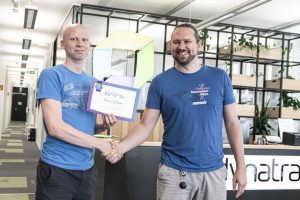
With his master thesis about “Animating Characters using Deep Learning based Pose Estimation”, Fabian Schober won the “Dynatrace Outstanding IT-Thesis Award” (DO*IT*TA). The award brings attention to extraordinary theses, motivates creativity, and provides insight into modern technologies.
In his thesis, Fabian Schober focuses on animating 2D (video game) characters using the PoseNet pose estimation model. He delivers a proof of concept on how new machine learning technologies can assist in video game development. Read more at the University press release (German only).

Title: “A Two-Sided Matching Model for Data Stream Processing in the Cloud-Fog Continuum” by: Narges Mehran, Dragi Kimovski and Radu Prodan, was virtually presented in the CCgrid2021 conference.
We at @alpenadriauni are proud of Narges and her work in the @EU_H2020 @DataCloud2020 project awarded at cloudbus.org/ccgrid2021/.
Watch award presentation at: https://www.youtube.com/watch?v=aSnzDpd5Kqc

 We are happy and proud to see Bitmovin among the 72nd Annual Technology & Engineering Emmy® Awards Recipients. The award is received for “Development of Massive Processing Optimized Compression Technologies” which acknowledges Bitmovin’s Encoding product including its reportedly best per-title encoding feature.
Bitmovins press release can be found here and approximately one year we had the official opening ceremony of the ATHENA project that will continue to fed the innovation pipeline with respect to HTTP Adaptive Streaming (HAS) and beyond. Please see our latest publications in this field and in case of questions please do not hesitate to contact us.

September 24, 2020. Bitmovin received 2nd prize of the 2020 Houska Award for the PROMETHEUS project, a joint project with the Alpen-Adria-Universität Klagenfurt funded in part by the Austrian Research Promotion Agency (FFG) in the “Basisprogramm”. The Houska Award is Austria’s biggest private award for application-oriented research and comprises two categories: (i) academic research; (ii) research & development in SMEs. Bitmovin was nominated in the second category and received the 2nd prize of this prestigious award in Austria.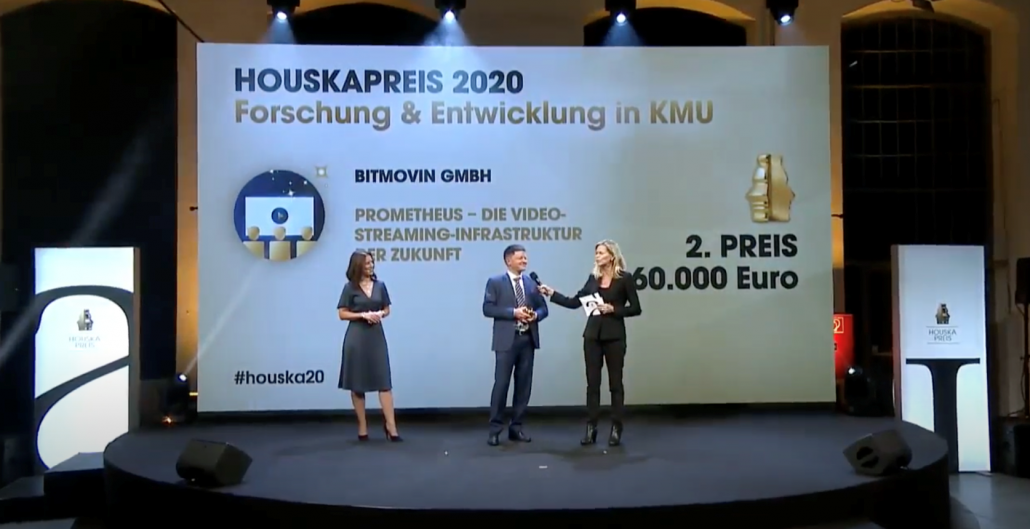
The main objective of PROMETHEUS is to research and develop the next generation video streaming infrastructure to
– enable the efficient and optimized adaptive streaming of bandwidth-hungry interactive video applications – including but not limited to augmented reality, virtual reality, and omnidirectional 360° video – within heterogeneous environments;
– support immersive media applications taking into account recent advances in media coding (i.e., high-dynamic range, white color gamut, and other range extensions) as well as proprietary formats depending on the market needs (e.g., AV1, VP9, etc.);
– provide means to quantify the Quality of Experience (QoE) of the above mentioned applications domains in order to analyze and improve the video quality on the Web.
Project leaders:
– Stefan Lederer and Christopher Müller (Bitmovin)
– Christian Timmerer (Alpen-Adria-Universität Klagenfurt / Bitmovin)
Short videos about the project are available here (in German)
– https://www.youtube.com/watch?v=zcJpG6bz5-w
– https://www.youtube.com/watch?v=m_61kZuIn5Y
Research activities/results of PROMETHEUS can be found here: https://campus.aau.at/cris/project/0f4de0c95dc78fbf015dcc4fe70000c8?lang=en&#links
Further details about the Houska Award can be found here (in German): https://bcgruppe.at/houskapreis/

Faculty of Technical Sciences, University of Klagenfurt nominated Alexander Lercher from ITEC (Radu Prodan‘s group) for Best Performer Award owing to his outstanding performance in studies. He will be conferred with this honor at a public presentation in lecture hall -3 of the University of Klagenfurt on September 16, 2020. In the course of research carried out by the Studies and Examination Department, Alexander was identified as the most successful student in this field of study.

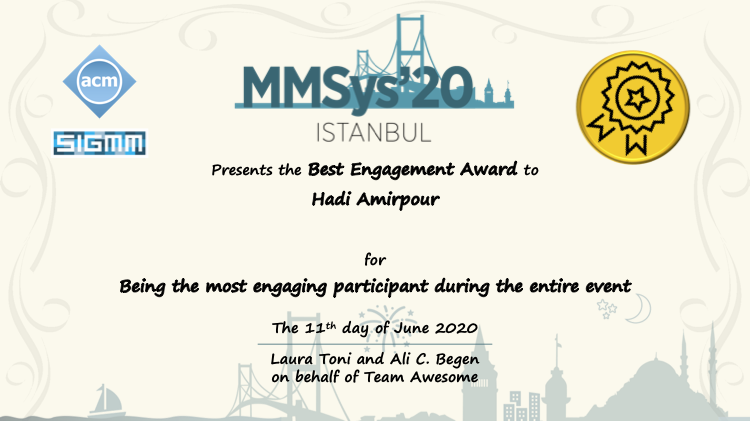 This year’s ACM MMSys was held as a fully virtual/online event and Slido was used for asking questions about keynotes and presentations including offline discussions with presenters. The interaction report provides some interesting key insights including the word cloud below which provides an overview of this year’s discussion items. Although ACM MMSys 2020 is over, everyone is welcome joining the MMSys Slack workspace where the discussion will continue until ACM MMSys 2021 (available soon!) and hopefully beyond.