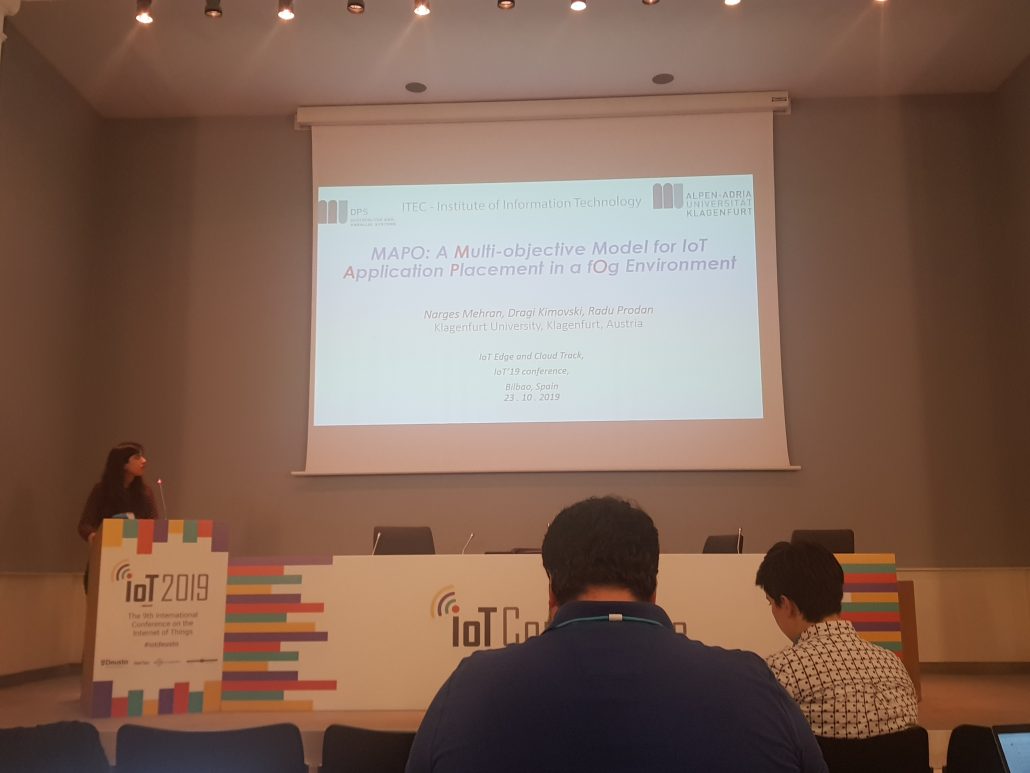
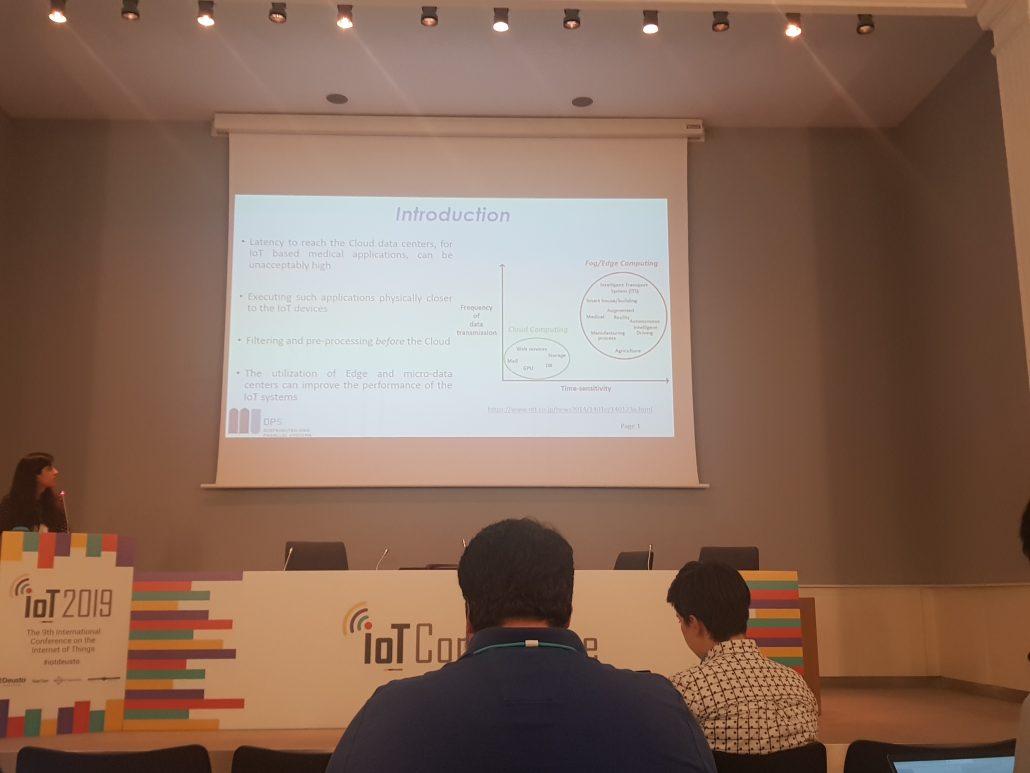
Narges Mehran presented the paper  “MAPO: A Multi-Objective Model for IoT Application Placement in a Fog Environment” at the 9th International Conference on the Internet of Things, IoT 2019 in Bilbao, Spain (October 22-25, 2019).

Authors: Narges MehranDragi KimovskiRadu Prodan (Alpen-Adria Universität Klagenfurt).

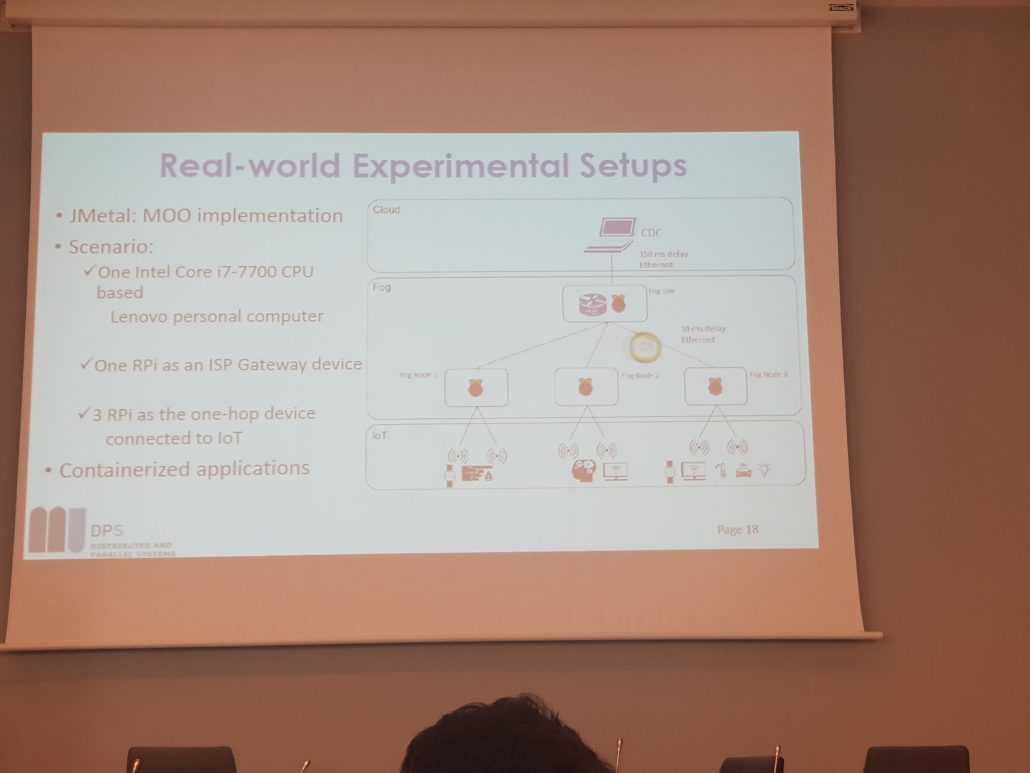
Abstract: The emergence of the Fog computing paradigm that leverages in-network virtualized resources raises important challenges in terms of resource and IoT application management in a heterogeneous environment with limited computing resources. In this work, we propose a novel Pareto-based approach for application placement close to the data sources called Multi-objective IoT Application Placement in fOg (MAPO). MAPO models applications based on a finite state machine using three conflicting optimization objectives, completion time, energy consumption, and economic cost, and considering both the computation and communication aspects. In contrast to existing solutions that optimize a single objective, MAPO enables multi-objective energy and cost-aware application placement. To evaluate the quality of the MAPO placements, we created both simulated and real-world testbeds tailored for a set of medical IoT application case studies. Compared to the state-of-the-art approaches, MAPO reduces the economic cost by 28%, while decreasing the energy requirements by 29-64% on average, and improves the completion time by a factor of six.

Track: IoT Edge and Cloud @IoT’19
Acknowledgement: Austrian Research Promotion Agency (FFG), project 848448, Tiroler Cloud, funded this work.

Prof. Radu Prodan

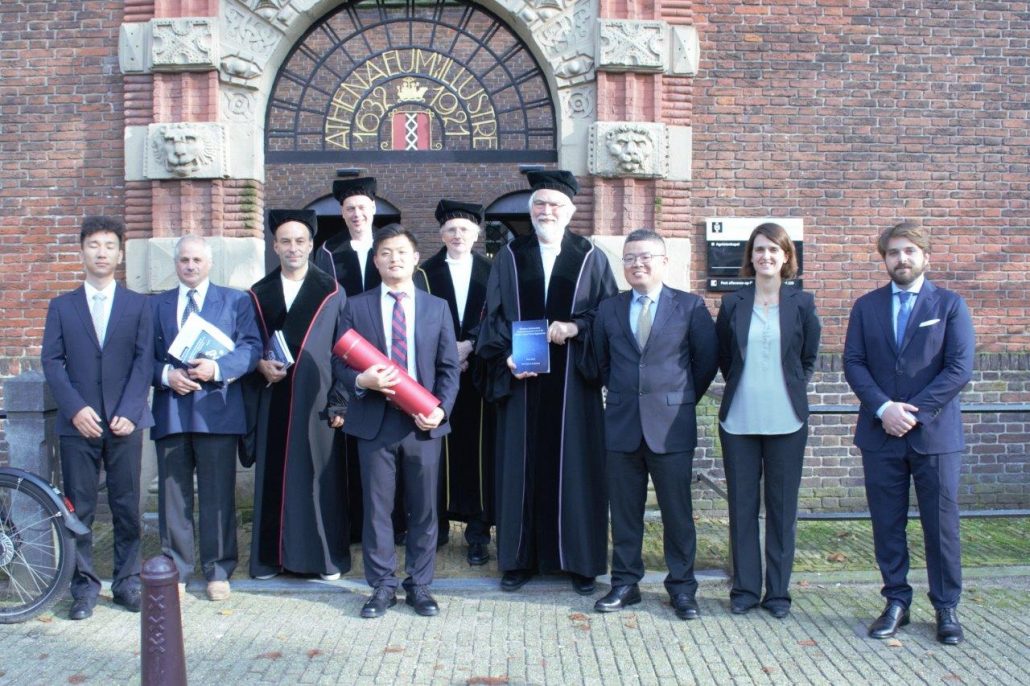
Prof. Radu Prodan participated at the PhD examination of Dr. Yang Hu and Dr. Huan Zhou at the University of Amsterdam, Netherlands.

With: Prof. Peter van Emde Boas, Prof. Cees de Laat, Prof. Henri E. Bal, Dr. Paola Grosso, Dr. Zhiming Zhao, Prof. Rob van Nieuwpoort, Prof. Pieter Adriaans, Dr. Adam S.Z. Belloum

Read more about the High level Symposium.

BlockchainITEC is delighted to announce the next speaker in our guest lecture series – Dr. Antorweep Chakravorty from University of Stavanger and bitYoga, Norway. The course will take place from November 18 – 29, 2019

This course presents an introduction and further information about the high-interest topic blockchains. Please register at the course 623.714.

Further information is available HERE.

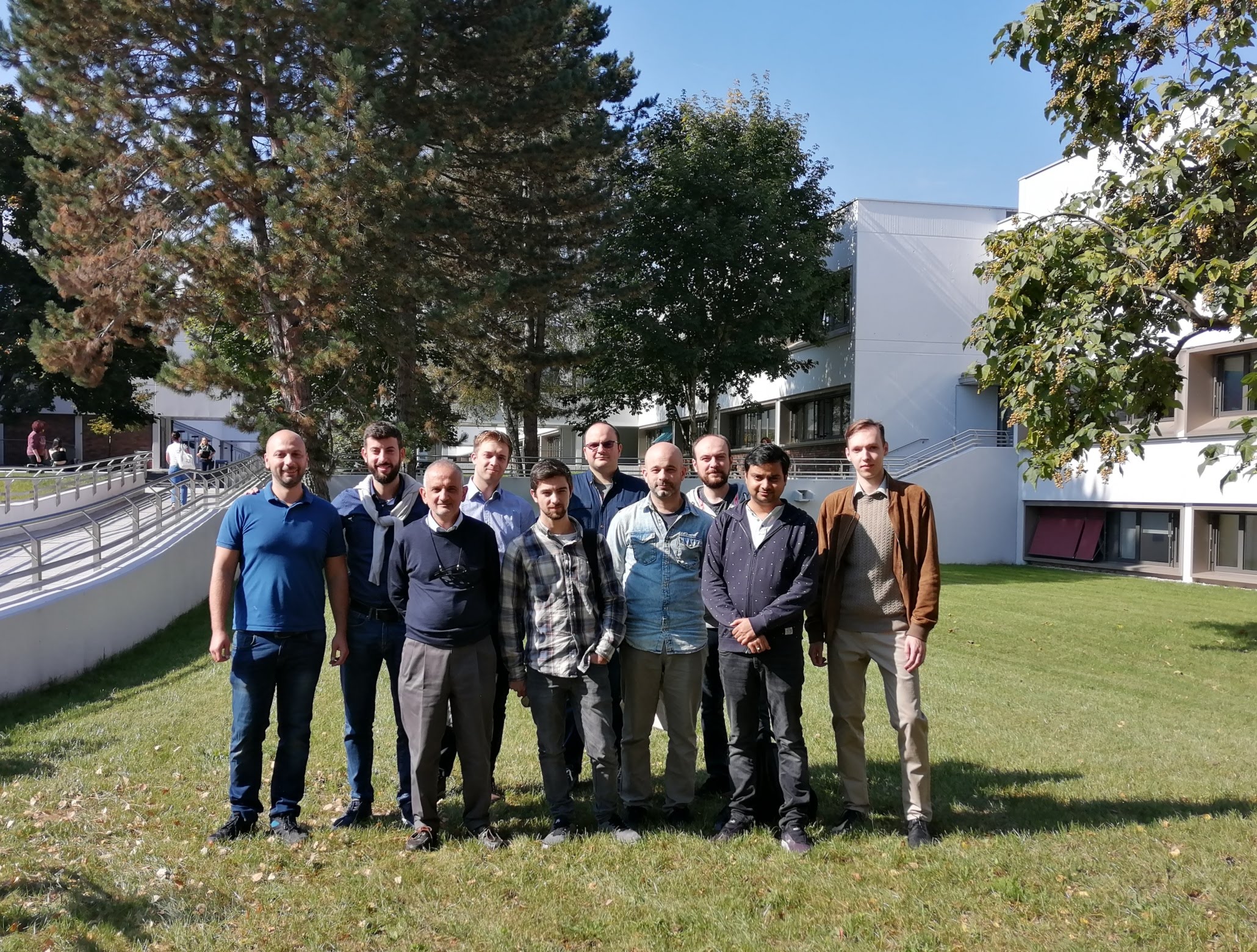
The Klagenfurt University hosted the first ASPIDE technical meeting (30th September – 2nd October), which aims on designing scalable software solutions for exascale computing.

2019 ASPIDE Meeting Klagenfurt

ASPIDE Meeting at Klagenfurt University

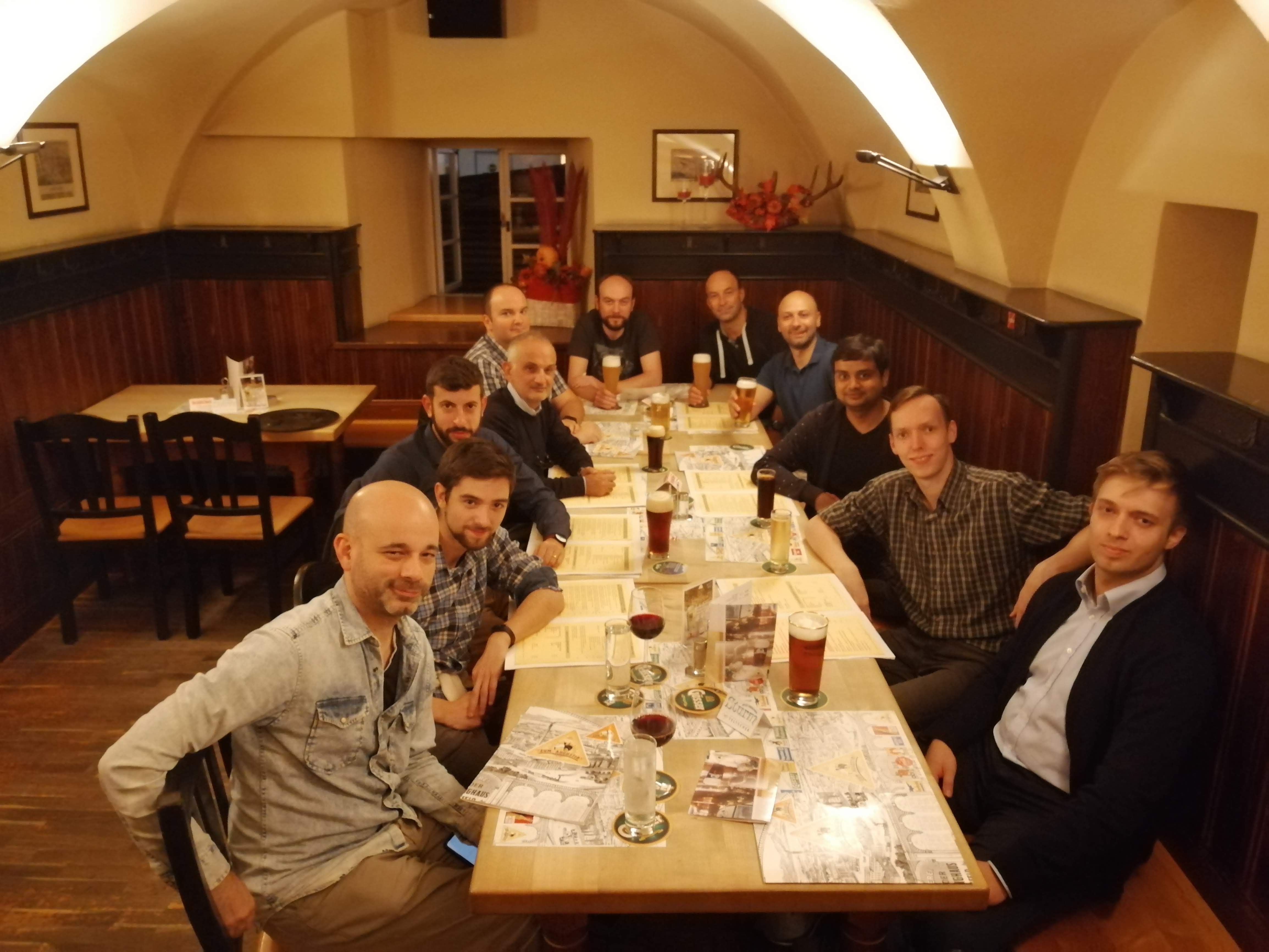
2019 ASPIDE Meeting Klagenfurt Social Event

2019 ASPIDE Meeting Klagenfurt (Social Event)

Philipp Moll

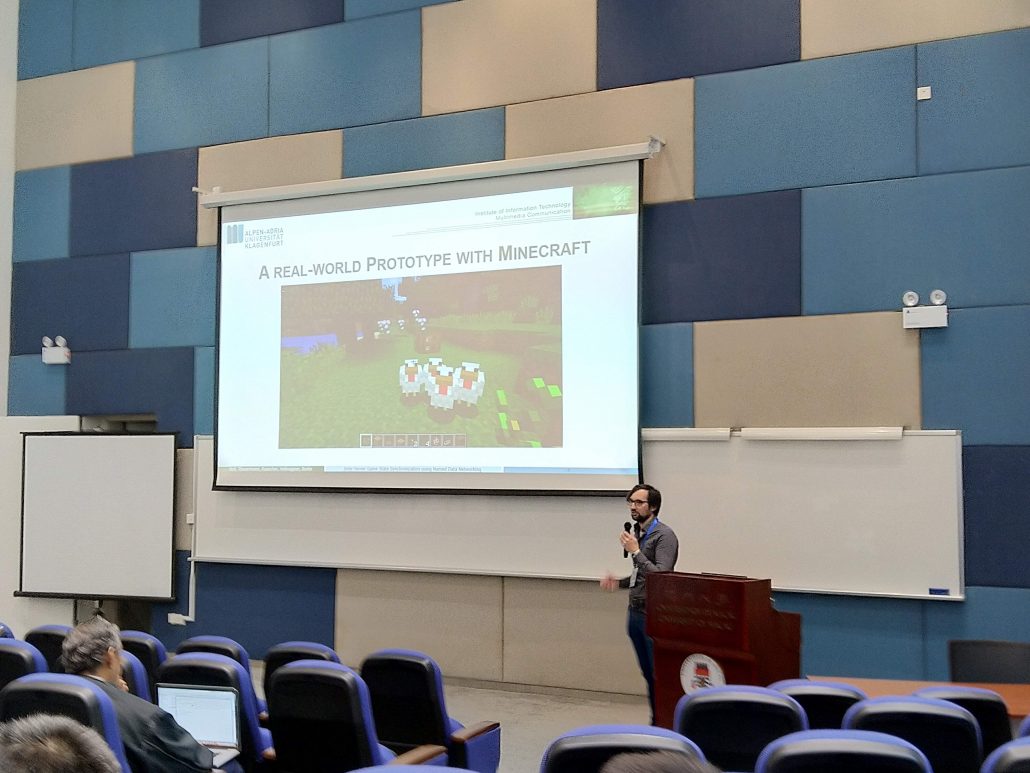
Philipp Moll presented the paper “Inter-Server Game State Synchronization using Named Data Networking” on the ACM Conference on Information-Centric Networking 2019 in Macau, China.

Authors: Philipp Moll, Sebastian Theuermann, Natascha Rauscher, Hermann Hellwagner (Alpen-Adria-Universität Klagenfurt), Jeff Burke (UCLA)

Abstract: In this paper, we develop a system for inter-server game state synchronization using the NDN architecture. We use Minecraft as a real-world example of online games and extend Minecraft’s single-server architecture to work as multi-server game. In our prototype,we use two different NDN-based approaches for the dissemination of game state updates in server clusters. In a naive approach, servers request game state updates for small segments of the game worldfrom other servers of the cluster. In an improved approach – the region manifest approach– servers identify changed parts of the world by subscribing to manifest files containing information about world regions managed by the other servers of the cluster. An apparent downside of the NDN approaches is the high overhead when handling small-sized game state updates, but our evaluation shows that NDN already improves on IP-based implementations regarding the resulting traffic volume when three or more servers are involved. Furthermore, caused by NDN’s inherent multicast functionality, the advantage over IP increases with the size of theserver cluster. Moreover, the use of NDN-based approaches leads to benefits beyond traffic reduction only. The name-based host-independent access to world regions allows to scale server clusters easier.

The paper full paper can be found on: https://conferences.sigcomm.org/acm-icn/2019/proceedings/icn19-25.pdf

Christian Timmerer

The ACM Multimedia Systems Conference (MMSys) is held June 8-11, 2020 in Istanbul, Turkey and provides a forum for researchers to present and share their latest research findings in multimedia systems. While research about specific aspects of multimedia systems are regularly published in the various proceedings and transactions of the networking, operating systems, real-time systems, databases, mobile computing, distributed systems, computer vision, and middleware communities, MMSys aims to cut across these domains in the context of multimedia data types. This provides a unique opportunity to investigate the intersections and the interplay of the various approaches and solutions developed across these domains to deal with multimedia data types.

General Chairs
— Ali C. Begen (Ozyegin University and Networked Media, Turkey)
— Laura Toni (University College London, UK)

TPC Chairs
— Özgü Alay (Simula Metropolitan and University of Oslo, Norway)
— Christian Timmerer (Alpen-Adria-Universität Klagenfurt and Bitmovin, Austria)

Link: ACM MMSYS 2020

Abstract: Video streaming is one of the top traffic contributors in the Internet and a frequent research subject. It is expected that streaming traffic will grow 4-fold for video globally and 9-fold for mobile video between 2017 and 2022. In this paper, we present an automatized measurement framework for evaluating video streaming QoE in operational broadband networks, using headless streaming with a Docker-based client, and a server-side implementation allowing for the use of multiple video players and adaptation algorithms. Our framework allows for integration with the MONROE testbed and Bitmovin Analytics, which bring on the possibility to conduct large-scale measurements in different networks, including mobility scenarios, and monitor different parameters in the application, transport, network, and physical layers in real-time.

Authors: Cise Midoglu (Simula), Anatoliy Zabrovskiy (AAU), Özgü Alay (Simula), Daniel Hölbling-Inzko (Bitmovin), Carsten Griwodz (Univ. of Oslo), Christian Timmerer (AAU/Bitmovin)

Keywords: adaptive streaming, network measurements, OTT video analytics, QoE

Link: ACMMM 2019