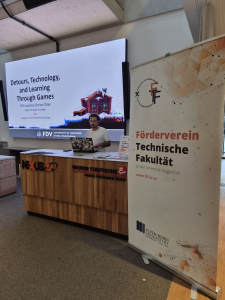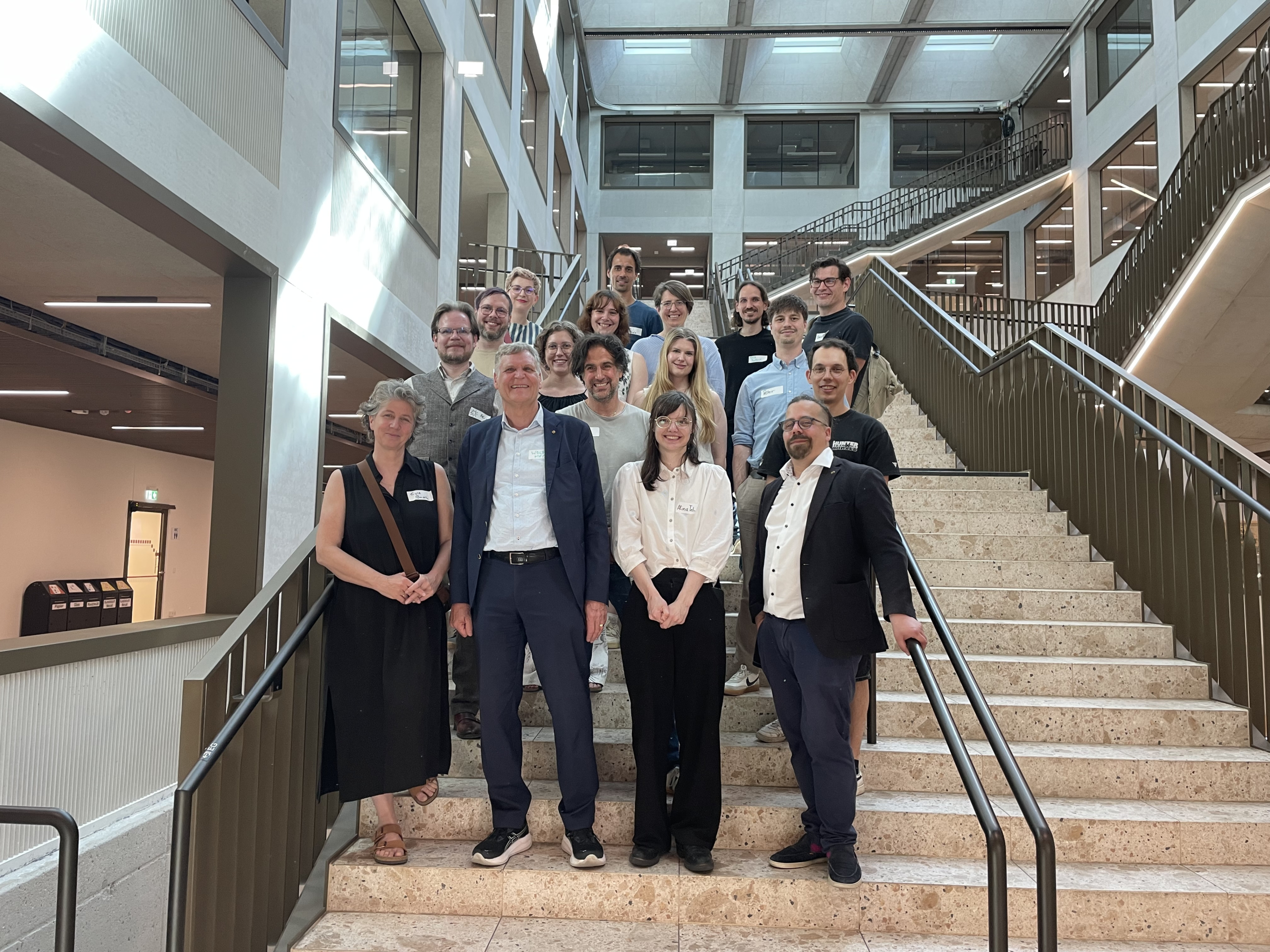
On 20 April, Alison Grant, the Canadian ambassador to Austria, visited the University of Klagenfurt. As a part of an exclusive delegation, Dr. Felix Schniz accompanied the ambassador on a tour through campus grounds and the Lakeside Science & Technology Park, showcasing the appeal of the interdisciplinary Master’s Programme Game Studies and Engineering, the role of AAU as a hub of the technical sciences, the shared focal points of video game focused research in Canada and Austria, and local tech-focused organisations and support networks such as the FTF.

On 16 April, Dr Felix Schniz (ITEC) organised a guest talk and workshop by Flavia Mazzanti and Manuel Bornell from Immerea (www.immerea.com). Supported by the FTF and co-organised by DI Dr. Martina Tritthart (Visuelle Kultur), the dual event introduced students of both programmes and visitors alike to contemporary digital art in the era of VR technologies, computer graphics, and generative AI under an interdisciplinary, technology-oriented angle. While the guest talk focused on the recent art installations of Immerea, the workshop allowed participants to explore opportunities in the creation of arts via blender and other common tools firsthand. Both events were well visited, highlighting the drawing power of cutting-edge technology research from a humanities, tech-interested perspective.


Title: Dynamic Participatory Game Design with Local AI: From Interviews to Trauma-Aware Interactive Narratives

Authors: Kseniia Harshina, Tom Tucek, Mathias Lux

Location: TextStory 2026 – Delft, The Netherlands, March 2026

Abstract: We present a work-in-progress, trauma-aware participatory storytelling pipeline that uses a locally hosted large language model (LLM) as a neutral chatbot interviewer. The system supports self-paced narration without cloud processing, prioritizing privacy, data sovereignty, and participant control. Interview transcripts are transformed into a structured scene representation (extracted fields and dialogue prompts), which is then replayed through a lightweight prototype interface as an initial step toward interactive memory-based experiences. We report a small formative expert evaluation (n=2) focusing on perceived comfort, emotional safety, and usability. Participants described the interviewer as low-pressure and reflective, while highlighting limitations such as weak acknowledgement of long answers and occasional “forced turns.” We discuss design implications for narrative extraction, turn-taking, and staged evaluation in sensitive contexts, and outline next steps for community-informed studies with participants who have lived experience of displacement.

Ttitle: Tell Your Story Through Games (TYS):  Preliminary Guidelines for Mixed-Migrant Participatory Game Jams

Conference: The 3rd Geogames Symposium (3GGS) – Iowa, USA

Authors: Kseniia Harshina

Abstract: Migration-themed games are often framed as “empathy machines,” inviting outsiders to temporarily inhabit another’s hardship. This framing can slide into identity tourism and reinforce the trope of the “helpless refugee”. This short paper presents Tell Your Story Through Games (TYS) as a participatory game jam method that centers agency, and self-expression in mixed-migrant communities. We contribute preliminary methodological guidelines for running participatory story game jams with mixed-migrant communities. Participants with lived experience of migration and/or displacement create place-based story games, choosing how personal or fictional they want the story to be. One pilot iteration has been completed; future iterations will refine the method and evaluate its support for narrative agency and community-building.

Title: Pleasure Not For Everyone: Epistemic Injustice Towards Ukrainian Game Studies

Conference: 17th Annual DiGRA Conference

Authors: Kseniia Harshina, Mark Maletska

Abstract: Calls for playfulness in research often emphasize joy and learning, yet play and games can also exclude and harm minoritized participants—including within academia. In game studies, debates on diversity and postcoloniality have grown, but they still tend to center Western/Western European perspectives, which can obscure other forms of marginalization inside “Europe,” including Eastern Europe. This extended abstract summarizes an in-progress collaborative autoethnography by Ukrainian game studies scholars. Using Fricker’s concept of epistemic injustice, we argue that Ukrainian scholars face a dual barrier to participation in game studies: (1) structural inaccessibility within Ukraine (e.g., disrupted institutions, limited resources and mobility) and (2) epistemic misrecognition within Western institutions (e.g., being treated as subjects of humanitarian concern rather than credible theory producers). Together, these barriers shape who can enter the field and which knowledge is considered legitimate.


On 8 January 2026, Dr Felix Schniz held a guest presentation at the University of Graz. Invited by the Department of English, his talk focused on the narrative capabilities of video games:


Video Games as Storytelling Worlds

The capacities for narrative superstructures in video games are often depicted as being at odds with their elementary interactivity. From the game studies defining faux-skirmish between ludology and narratology, the question of spatial narrative capacities, and steadily refining perspectives on the literary purpose of video games, the central question remained ever the same: What is the connection between agency and the literary?


This lecture session explores the question in depth. It builds on an approximate definition of the multidisciplinary and complex medium to map its historical literary emancipation. Following this overview, concrete examples are used to evaluate the usage of literary key terminology for the analysis of video games. A distinct focus is set on the unique potential for interactive storytelling in video games.

December 19-21, 2025
Organized by: Tom Tucek, Patrick Mieslinger

With help from: Bodo Thausing, Kristell Potocnik, Agon Guri

With 63 participants and 15 submitted games, this year’s winter game jam has concluded just before the winter holidays.

Students, teachers, alumni, and even individuals not directly affiliated with the university came together to create new video games from scratch, all within a 48-hour time frame. The topic this time was “Resistance”.

A big thank you to everyone who participated or helped; you made this event a big success once again!

Please feel free to check out all the games here:

https://itch.io/jam/klujam-ws25


On November 14, Dr Felix Schniz held a workshop for Master Students wishing to pursue an academic career related to game studies and game engineering. Invited by ÖH representatives, he focused on the first conference presentation, including topics such as abstract writing, conference etiquette, and publishing a conference paper.

On 22 October 2025, Dr Felix Schniz opened the newly founded Media Club of AAU with a spectacular guest lecture. Founded by the Department of English, the Media Club has been installed to offer students an extracurricular and multidisciplinary journey through a leitmotif every semester. Starting with “Dystopia” in Winter 2025, Felix Schniz took the audience onto a journey through the video game “Hellblade: Senua’s Sacrifice” and reminisced on technological and psychological facets of game design.

On 24 September 2025, Senior Scientist Dr Felix Schniz held a workshop on Tarot cards for the youth centre kwadr.at in Klagenfurt. Over the course of three hours, he educated a very excited crowd on the history of the cards, their purpose for divination and self-reflection, Tarot-card-based games, and what card games have to do with modern computer games. kwadr.at is a space for young people aged about 14 to 27 to hang out, be creative, and participate in cultural or social activities