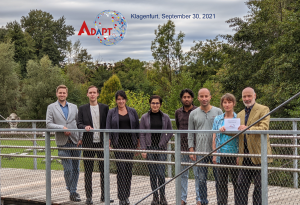
The first face-to-face ADAPT Meeting took place on September 30, 2021, in Klagenfurt. The consortium discussed important aspects of systems integration, current achievements and listed down strategies for validating and exploiting ADAPT use cases through real-world testing and external collaboration. The consortium further agreed to continue its ongoing efforts in disseminating scientific and technical results.

ARTICONF impressed the reviewers with their advancements in the second year and passed the second EC review with flying colors.  The project officer and reviewers echoed the effort put together by the consortium in achieving an integrated ARTICONF product while maintaining a pile of scientific output at the highest level. The EC reviewers iterated that they look forward to the current ARTICONF technology with personal and professional interests apart from the bindings of their current EC responsibilities. 

This offer is an excellent opportunity to do a combined PhD at CERN and the University of Klagenfurt. If you are interested, find more information here.

ITEC is delighted to announce the next speaker in our guest lecture series – Prof. Carsten Griwodz from the University of Oslo & SIMULA Research Laboratory, Norway. The online-course will take place from March 5 – May 28, 2021.

This course is meant to provide the participants with the means for evaluating end-user satisfaction with interactive applications. Please register at the course 780.411.

Further information is available HERE.

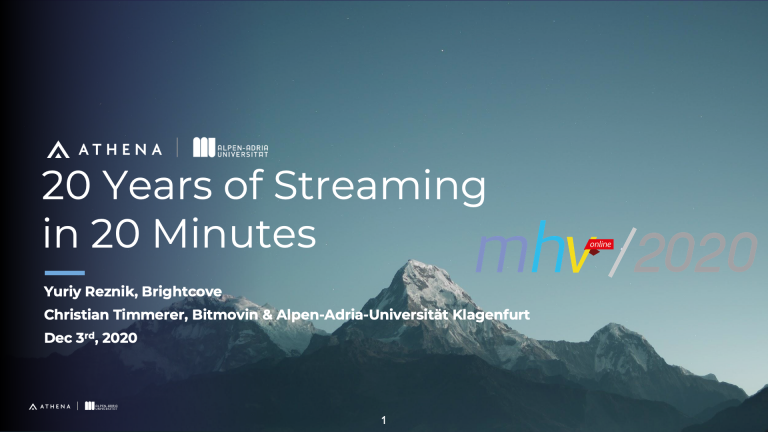
Further details and registration available here: https://mile-high.video/

Teaching in times of Corona is a particular challenge. An online survey among AAU students shows that they were delighted with the digital teaching formats. Here you will find the best feedback from the students:
https://www.aau.at/feedback-zur-online-lehre/

Josef received very positive reviews, for example: “The course became more and more enjoyable, not only because of the content but also because of the technical aids: He integrated special effects, course intro, applause at the weekly quizzes, which significantly loosened the atmosphere.”


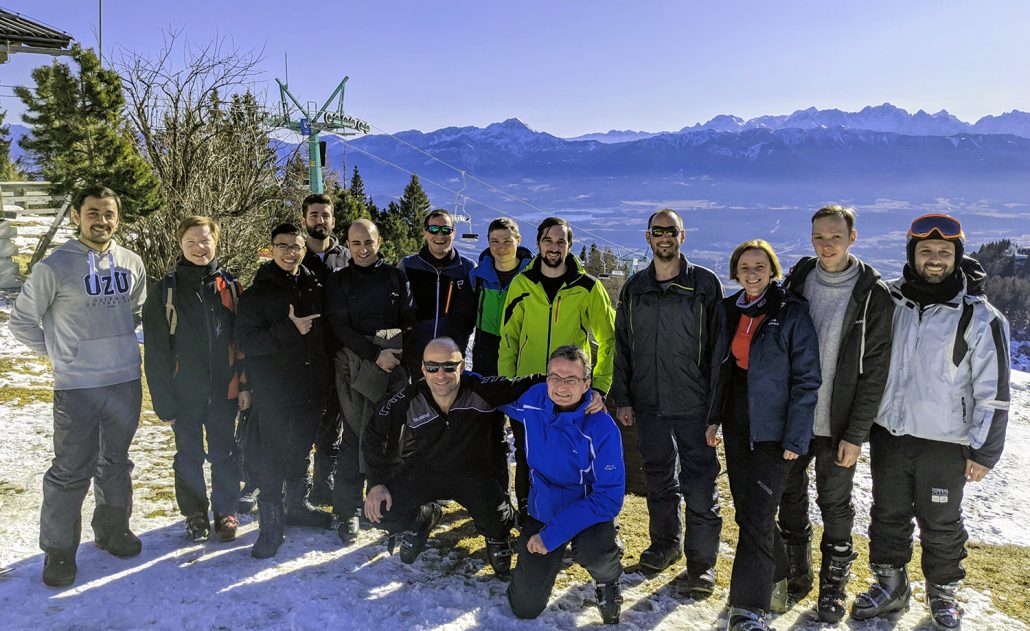
To strengthen our team spirit, ITEC members spent a wonderful skiing day together at Gerlitzen.

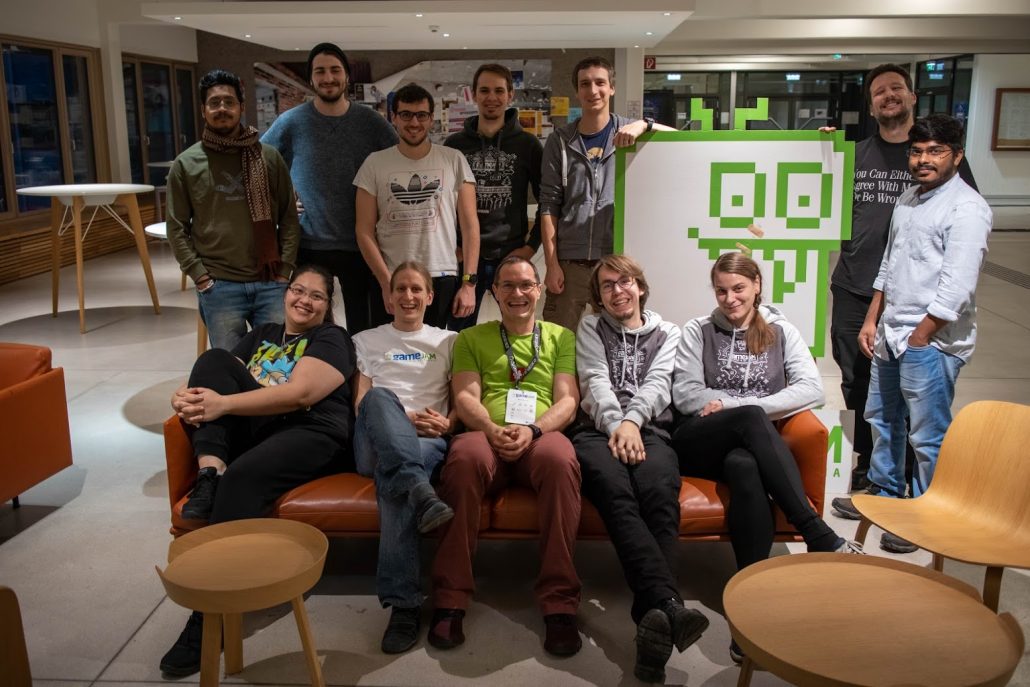
The 3rd Klagenfurt Winter Game Jam took place Dec 20-22, 2019 and attracted more than 90 registrations. The event started with talks about the founding of an indie studio – Healing Bullet Games – from students of our master program on Game Studies and Engineering, and about game streaming from Marie Solle. More than 60 jammers then worked on games with the topic Unconventional Travel for the whole weekend, and 16 games where presented on Sunday. All the games of the jam can be found on https://itch.io/jam/3rd-winterjam/entries.

Photos from the jam are available at https://photos.app.goo.gl/Pet8u9JUkg7eJif89, moving images are here: https://youtu.be/FDWeyKjLnog

The paper “Deblurring Cataract Surgery Videos Using a Multi-Scale Deconvolutional Neural Network” has been accepted for publication at the “IEEE International Symposium on Biomedical Imaging”, located at Iowa City, Iowa, USA (April 3-7, 2020). This conference is a joint initiative from the IEEE Signal Processing Society (SPS) and the IEEE Engineering in Medicine and Biology Society (EMBS).
Authors: Negin Ghamsarian, Klaus Schoeffmann, Mario Taschwer

Abstract: A common quality impairment observed in surgery videos is blur, caused by object motion or a defocused camera. Degraded image quality hampers the progress of machine-learning-based approaches in learning and recognizing semantic information in surgical video frames like instruments, phases, and surgical actions. This problem can be mitigated by automatically deblurring video frames as a preprocessing method for any subsequent video analysis task. In this paper, we propose and evaluate a multi-scale deconvolutional neural network to deblur cataract surgery videos. Experimental results confirm the effectiveness of the proposed approach in terms of the visual quality of frames as well as PSNR improvement.

Keywords: Video Deblurring, Deconvolutional Neural Networks, Cataract Surgery Videos

Acknowledgment: This work was funded by the FWF Austrian Science Fund under grant P 31486-N31