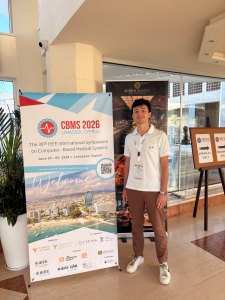
Paper presented @ IEEE CBMS 2026
Last week, Francesco Marchetto and Klaus Schoeffmann presented their work on synthetic data generation for surgical image synthesis at IEEE CBMS 2026 (Computer-Based Medical Systems) conference in Limassol, Cyprus. Their paper, entitled “Hybrid Semantic Augmentation for Cataract Surgery Image Synthesis with GANs and Diffusion-based Models”, investigated how augmenting semantics in conditional generative models can be used to overcome the critical shortage of annotated training data in surgical AI.
The work introduced a student-teacher augmentation framework in which a trained generative model acts as a teacher to produce synthetic surgical images for a student model. Two augmentation strategies were evaluated: a naive mask re-generation approach that varies image appearance while preserving semantic layout, and a novel Hybrid Anatomy Injection strategy that procedurally generates new semantic masks by compositing surgical instruments onto real anatomical backgrounds. Experiments on the Cataract-1K dataset showed that the proposed semantic augmentation achieves up to 24% improvement in Fréchet Inception Distance over the baseline. By exposing the model to novel instrument-anatomy configurations never seen during training, the semantic augmentation breaks the performance plateau that texture-only variation cannot overcome, enabling the model to continue learning beyond the limits of the original data distribution. For diffusion-based models, which carry strong pretraining biases from large-scale natural image datasets, mask re-generation proves more effective: providing more examples of how surgical scenes look helps these models gradually adapt their pretrained priors to the target domain. Together, these strategies demonstrate that meaningful performance gains in surgical image synthesis can be achieved entirely without collecting new patient data, offering a practical and privacy-friendly path toward more capable generative models in clinical settings.